Carl Jung — The Inventor of Alcohol-Free Wine

Rheingau · Rüdesheim
Carl Jung
The inventor of alcohol-free wine — a family cellar house since 1868.
The House
The inventor of alcohol-free wine
The name Carl Jung is woven into the very origin of alcohol-free wine.
Founded in 1868 in Rüdesheim am Rhein, in the heart of the Rheingau, the family company is run today in its fifth generation — from its home at Boosenburg Castle. More than 10 million bottles a year reach over 30 countries.
What sets Carl Jung apart is a craft: taking selected wine and gently lifting out the alcohol while keeping its aroma, structure and character — from a classic Mousseux to a certified organic line.
History
The 1907 patent
Around 1900 Carl Jung Junior asked a then-radical question: could you remove the alcohol from a fine wine without destroying the wine? In 1907 the Imperial Patent Office granted him the patent for his vacuum process — the birth of alcohol-free wine. The refined “Carl-Jung-Method” is protected by three patents to this day.
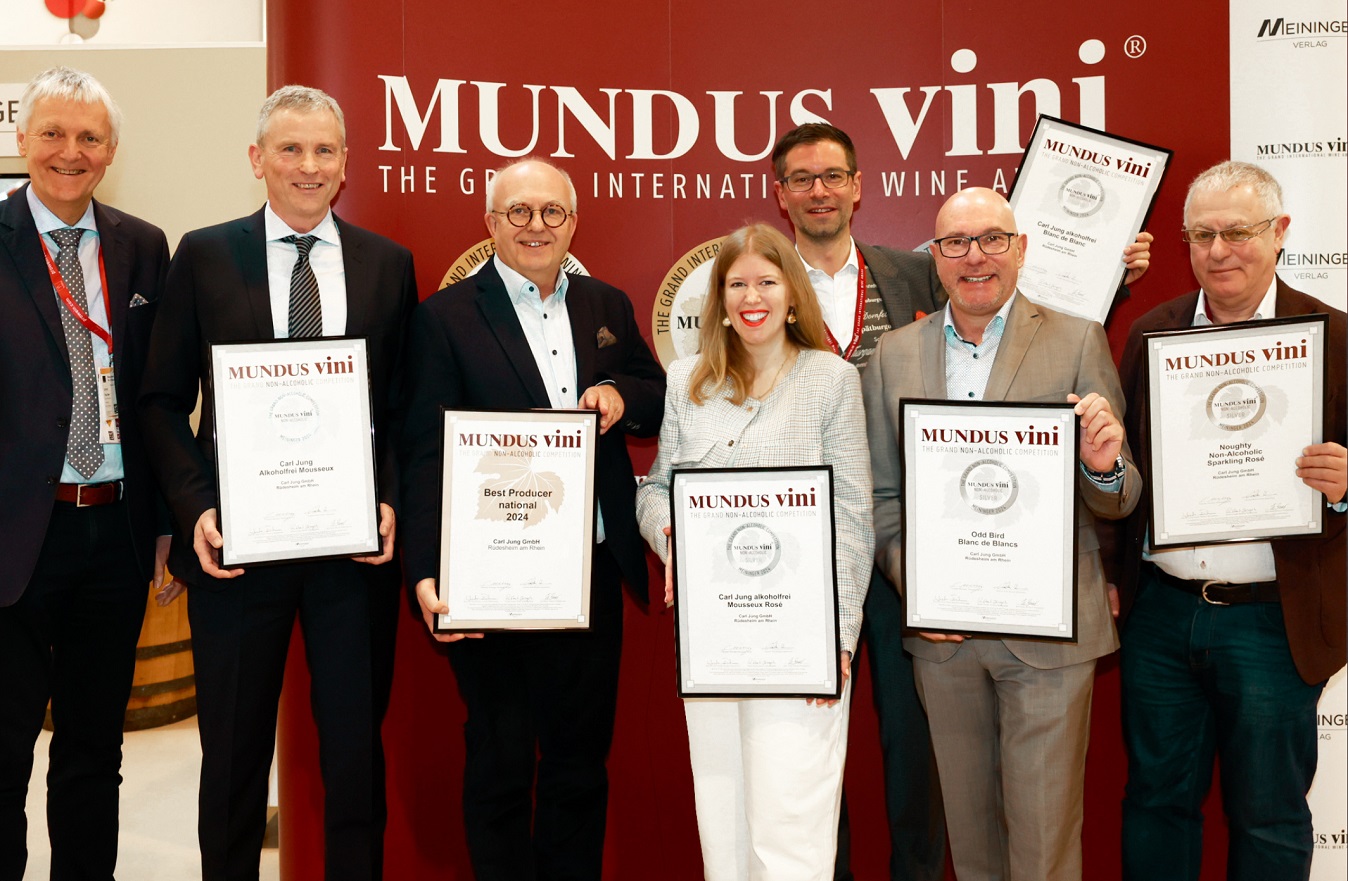
The Jung family (ProWein 2024) · Photo: Carl Jung
The People
Five generations of the Jung family
Today Bernhard and Teresa Jung keep the family present in the business, while managing director Dr. Bernd Kost (since 2026) leads the next chapter.
Drinking less alcohol should never mean drinking less well.
Terroir
Roots in the Rheingau

Carl Jung is, in the best sense, a cellar house rather than a single-vineyard estate. Its roots are in the Rheingau, one of Germany’s great Riesling regions. For its broad range the house draws on carefully selected base wines — each chosen for how well it carries through de-alcoholisation.
The Craft
The Carl-Jung-Method
A century of experience shows here — patented, gentle, refined across three patents.
Selected base wines
Carefully chosen wines, suited to gentle de-alcoholisation.
Vacuum extraction
Alcohol is removed under reduced pressure below 30 °C — heat is kept out.
Aroma recovery
The delicate aromatics are captured and returned to the wine — bouquet and minerality remain.
At the Table
How to serve it
Mousseux and Blanc de Blancs make a natural aperitif with canapés and sushi; reach for the Riesling with light fish and Asian dishes; Cabernet Sauvignon and organic Merlot with roasted vegetables and mature cheese.
Conscience
Organic and vegan, too
Alongside its classic range, Carl Jung offers a certified organic line — including organic Chardonnay, Merlot and Mousseux — grown organically and made vegan.
Legacy
A pioneer’s legacy
- 1907First patent — inventor of alcohol-free wine
- 3Patents — the Carl-Jung-Method
- 150Years of family tradition (1868–2018)
- 30+Countries supplied worldwide
The Collection
Carl Jung at alcfree.ch


See all Carl Jung wines at alcfree.ch